
For HVAC companies, the telephone is often where revenue begins.
A homeowner whose air conditioner stops working on a hot afternoon may not patiently wait for a callback. A family with no heat on a cold night may call several contractors until somebody answers.
That creates a major challenge for heating and cooling companies.
Your technicians may be working. Your office staff may be helping other customers. But the phone keeps ringing.
Every missed call can represent a repair, maintenance appointment, installation, or replacement opportunity that goes to another contractor.
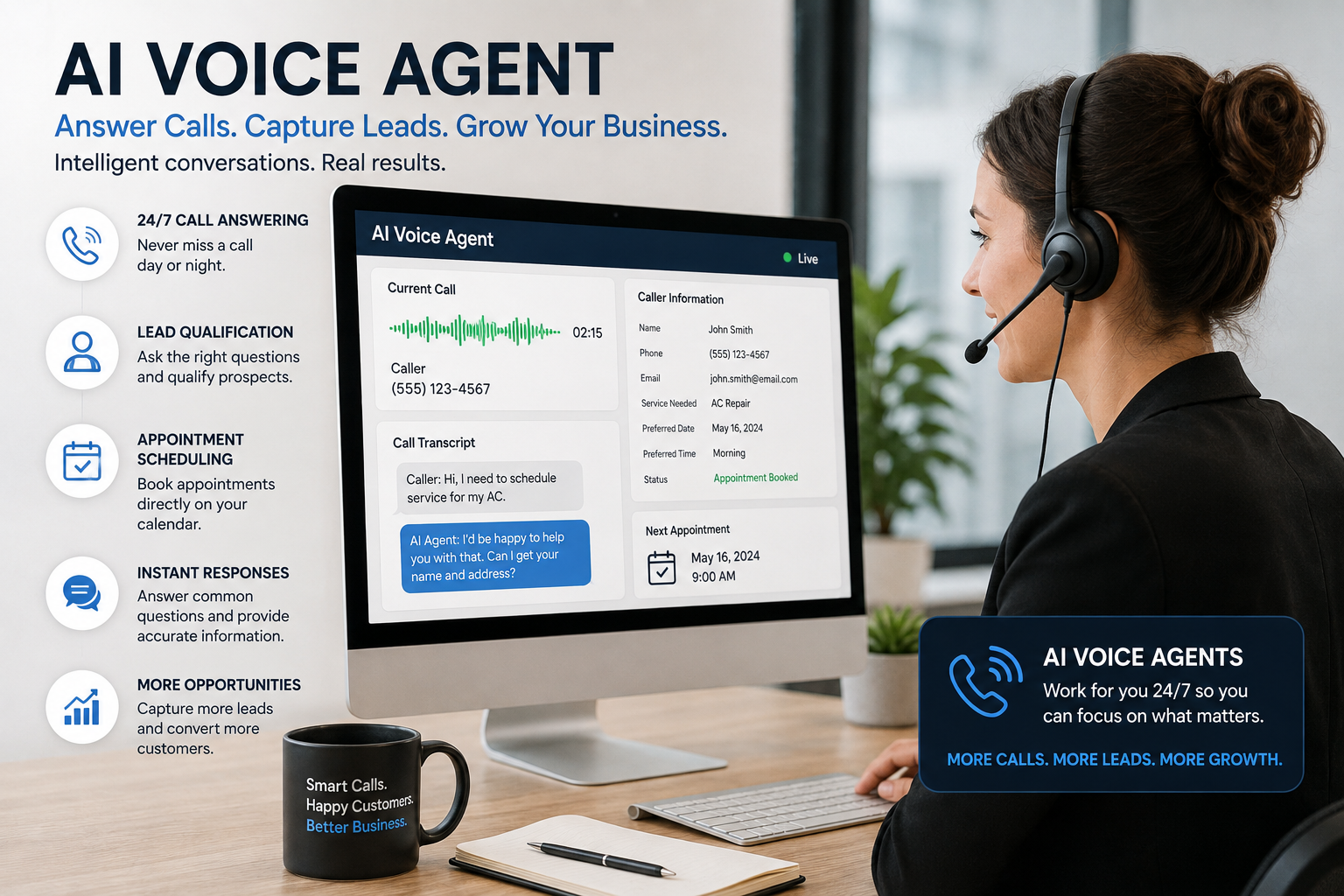
AI voice agents can help HVAC companies answer more calls, collect service information, qualify opportunities, schedule appointments, and provide coverage when employees are unavailable.
Why Missed HVAC Calls Are So Expensive
Many HVAC leads are different from ordinary business inquiries because the customer has an immediate problem.
They may be dealing with:
- An air conditioner that stopped cooling
- A heater that will not turn on
- Unusual noises from the HVAC system
- Poor airflow
- A thermostat problem
- A leaking unit
- A system that needs replacement
In many of these situations, customers want help quickly.
If the first contractor does not answer, the customer may immediately call the next company listed in search results.
That means missed calls can reduce the return on every marketing channel that generated those calls in the first place.
What Is an HVAC AI Voice Agent?
An HVAC AI voice agent is an artificial intelligence system designed to communicate with callers through natural spoken conversation.
Instead of sending every unanswered call to voicemail, an AI agent can greet the caller, determine what they need, ask relevant questions, and help them take the next step.
Depending on how it is configured, an HVAC voice agent may be able to:
- Answer incoming calls
- Provide after-hours coverage
- Collect customer contact information
- Identify the type of HVAC problem
- Determine service location
- Identify urgent requests
- Schedule service appointments
- Answer approved frequently asked questions
- Transfer qualified callers
- Send follow-up information
1. Answer HVAC Calls 24/7
Heating and cooling problems do not follow office hours.
Customers may call early in the morning, late at night, during lunch, on weekends, or while the entire office team is already helping other people.
An AI voice agent can be configured to answer around the clock.
That can give your HVAC business call coverage during:
- Evenings
- Weekends
- Holidays
- Lunch breaks
- Peak seasonal call periods
- Times when office staff are busy
Instead of simply hearing a voicemail greeting, the caller can immediately begin a conversation.
2. Capture Emergency and High-Intent Service Requests
Some HVAC calls are significantly more urgent than others.
A customer asking about annual maintenance is different from someone whose system has completely stopped working during extreme temperatures.
An AI voice agent can be designed to identify what type of problem the caller is experiencing.
For example, the agent may ask:
- Is your system running at all?
- Is the problem with heating or cooling?
- Is this for a residential or commercial property?
- What city or ZIP code are you located in?
- When did the problem begin?
- How soon do you need service?
The goal is not to diagnose the equipment. It is to collect useful information and route the customer appropriately.
3. Schedule HVAC Appointments During the Call
A lead is valuable, but a booked appointment is better.
When connected to a compatible scheduling system, an AI voice agent may be able to check available appointment times and help the caller schedule service immediately.
This reduces telephone tag and shortens the time between the customer's problem and the next step.
The caller may be able to finish the conversation knowing exactly when someone is expected to follow up or arrive.
This is one of the ways AI voice agents help small businesses capture more leads and turn incoming inquiries into scheduled opportunities.
4. Capture Leads While Your Technicians Are Working
HVAC technicians should not have to stop working every time the phone rings.
Yet many smaller contractors depend heavily on owners, technicians, or dispatchers to answer incoming calls.
An AI voice agent can handle the initial conversation so your team can stay focused on customers who are already scheduled.
The agent can collect:
- Name
- Phone number
- Email address
- Service address
- Type of problem
- Preferred service time
- Additional notes
5. Handle Seasonal Call Spikes
HVAC demand can change dramatically with the weather.
A sudden heat wave can cause dozens of homeowners to discover cooling problems within the same few hours. A major cold front can create similar demand for heating service.
A small office team can quickly become overwhelmed.
Depending on the platform and configuration, AI voice technology can handle multiple conversations at once.
That gives HVAC companies additional capacity during the periods when customer demand may be highest.
6. Answer Common HVAC Questions
Not every caller needs to speak with a technician.
Customers may simply want to know:
- What areas you service
- Your normal business hours
- Whether you offer emergency service
- Whether you service a certain type of HVAC system
- How to schedule an appointment
- Whether you offer maintenance plans
An AI voice agent can use an approved knowledge base to answer appropriate routine questions consistently.
That frees employees to focus on more complicated conversations.
7. Qualify Installation and Replacement Leads
Not all HVAC opportunities have the same value.
A system replacement or new installation can represent a significantly larger opportunity than a routine maintenance call.
An AI agent can identify callers who may be interested in higher-value services and collect preliminary information.
Questions might include:
- Are you looking for repair or replacement?
- Approximately how old is the current system?
- Is this for a home or commercial property?
- Are you the property owner?
- When are you hoping to complete the project?
Qualified opportunities can then be routed according to the company's sales process.
HVAC is one of many industries that can benefit from AI voice agents, particularly when incoming calls represent high-value sales or service opportunities.
8. Transfer Valuable Calls to a Real Person
AI does not have to replace human interaction.
In many HVAC businesses, the ideal system uses AI to handle the initial conversation and transfers certain callers to an employee.
A transfer might occur when:
- The caller requests a person
- The caller has an urgent service need
- The prospect is interested in a new HVAC system
- The caller is ready to move forward
- The question requires human judgment
This gives employees more opportunities to speak with high-value prospects while allowing AI to handle repetitive tasks.
9. Provide Better After-Hours Call Handling
Many HVAC contractors use voicemail after normal business hours.
The problem is that customers with urgent heating or cooling problems may not want to leave a message and wait until morning.
An AI voice agent can provide a more useful after-hours experience.
It can potentially:
- Answer immediately
- Identify the customer's problem
- Collect contact and service information
- Explain the company's approved after-hours process
- Schedule the next available appointment
- Escalate qualifying situations when appropriate
10. Support Outbound HVAC Follow-Up
AI voice agents can also support appropriate outbound workflows.
An HVAC company may want to follow up with people who:
- Requested information
- Submitted an online inquiry
- Asked for an estimate
- Need an appointment reminder
- Are due for maintenance
Outbound calling should be implemented in accordance with applicable consent, privacy, telemarketing, and communications rules.
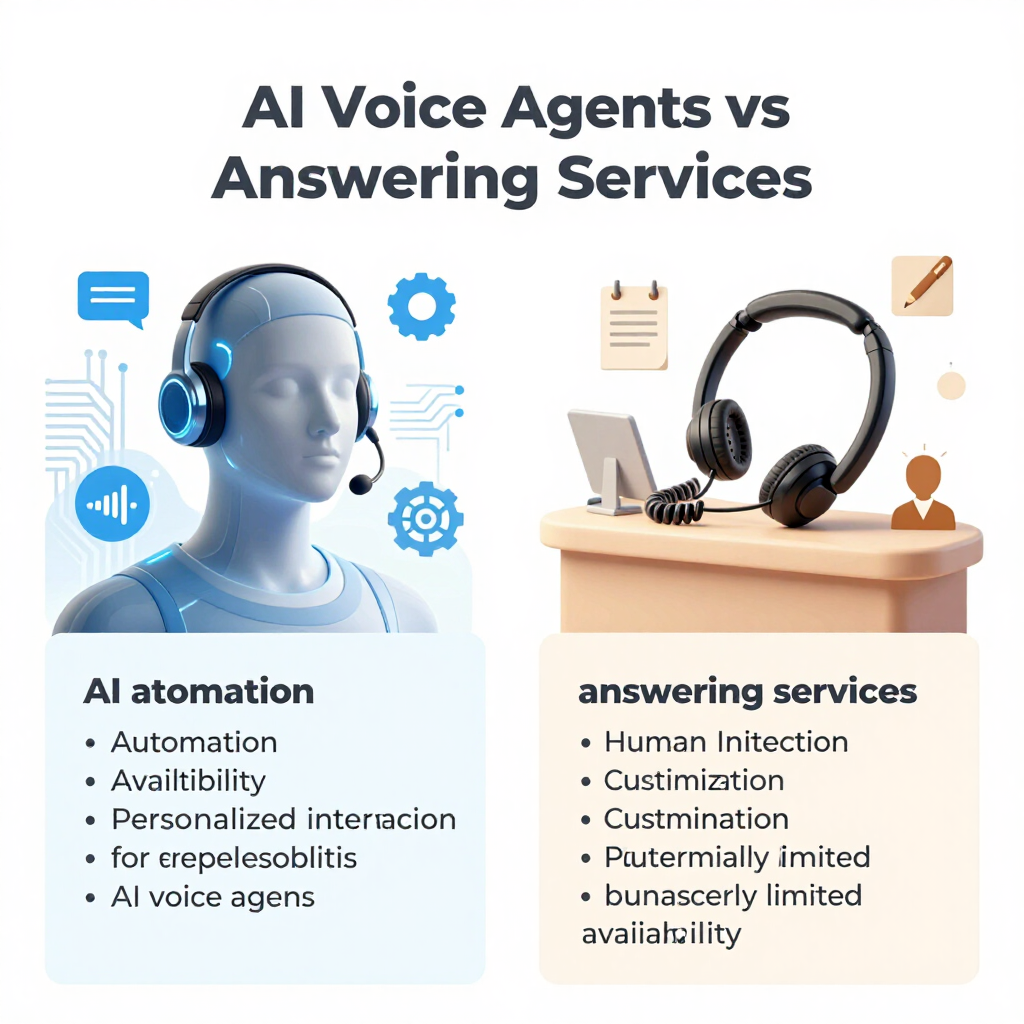
AI Voice Agents vs. Traditional HVAC Answering Services
Traditional answering services can provide useful human call coverage, but businesses should compare what each solution actually does.
A traditional answering service may:
- Answer the phone
- Take a message
- Follow a script
- Forward information
An AI voice agent may be configured to:
- Answer the call
- Identify the service needed
- Qualify the caller
- Collect detailed information
- Schedule an appointment
- Transfer qualified opportunities
- Send follow-up information
- Trigger additional workflows
For HVAC companies that want more than message-taking, this additional automation can be valuable.
How AI Voice Agents Can Improve HVAC Marketing ROI
Marketing becomes expensive when the business pays to generate leads but fails to answer them.
You pay for advertising, SEO, social media, direct mail, referrals, or another marketing channel.
A prospective customer sees the promotion and calls.
If nobody answers, that entire process may produce nothing.
An AI voice agent can help protect the value of your existing marketing by giving more callers an immediate response.
This is part of the broader shift toward AI automation for small businesses, where technology can handle repetitive interactions while employees focus on customers and higher-value work.
What Is One Missed HVAC Call Worth?
The financial impact of missed calls depends on the types of jobs your company handles.
A maintenance visit, repair, installation, and full-system replacement all have different values.
Missed qualified calls × close rate × average job value = potential lost revenue
Suppose an HVAC company misses 40 legitimate service inquiries in a month.
If only 25% would have become customers, that represents 10 jobs.
At an average initial job value of $500, those opportunities could represent approximately $5,000 in potential revenue.
Actual performance will vary, but the exercise helps illustrate the business value of answering more calls.
What Should an HVAC AI Voice Agent Know?
An HVAC agent may need information about:
- Services offered
- Service areas
- Business hours
- Emergency service policies
- Appointment procedures
- Types of HVAC systems serviced
- Maintenance programs
- Call-transfer rules
- After-hours procedures
- Frequently asked questions
The agent should also know when not to answer a question and when the caller needs to speak with a person.
AI Voice Agents Can Work With Your HVAC Team
The goal does not have to be replacing receptionists, dispatchers, or technicians.
AI can handle repetitive and predictable parts of the call while employees handle situations requiring expertise or judgment.
For example, the AI voice agent can collect basic information before transferring a qualified replacement prospect to sales.
The salesperson starts the conversation knowing what the prospect wants instead of beginning from zero.
Is an AI Voice Agent Right for Your HVAC Company?
Ask yourself:
- How many calls go unanswered?
- How many calls arrive after hours?
- How quickly are missed calls returned?
- What happens during seasonal call spikes?
- How much staff time is spent answering repetitive questions?
- Can customers schedule service immediately?
- How many valuable replacement opportunities are missed?
- What is an average new customer worth?
If incoming calls are an important source of business, improving the way those calls are handled may be one of the most direct ways to capture more revenue.
Stop Losing HVAC Jobs to Missed Calls
Stevendev Marketing builds customized AI voice agents for HVAC companies that want to answer more calls, capture more service requests, qualify leads, schedule appointments, and provide better after-hours coverage.
Your AI voice agent can be designed around your service area, appointment process, call-transfer rules, frequently asked questions, and the way your HVAC company actually operates.
Schedule a consultation with Stevendev Marketing and discover how an HVAC AI voice agent can help turn more incoming calls into booked jobs.
Frequently Asked Questions
What is an HVAC AI voice agent?
An HVAC AI voice agent is an artificial intelligence system that can communicate with callers, collect service information, answer approved questions, schedule appointments, and route calls according to the HVAC company's rules.
Can an AI voice agent answer HVAC calls after hours?
Yes. AI voice agents can be configured to answer calls outside normal business hours, including evenings and weekends.
Can an AI agent schedule HVAC appointments?
Yes. When connected to a compatible scheduling system, an AI voice agent can potentially check availability and help customers book service appointments.
Can an HVAC AI voice agent transfer calls?
Yes. Depending on the configuration, the agent can transfer callers to sales, dispatch, or another employee when predefined conditions are met.
Can AI voice agents handle emergency HVAC calls?
An AI agent can collect information about urgent service requests and follow the HVAC company's approved escalation procedures. It should not independently diagnose equipment or make safety decisions outside its configured instructions.
Can an AI voice agent help HVAC companies get more leads?
It can help capture more of the leads a company is already generating by answering calls that might otherwise be missed, qualifying prospects, and helping callers take the next step.