
One of the first questions businesses ask about AI voice agents is simple:
How much does one cost?
Unfortunately, there isn't one universal price.
The cost of an AI voice agent depends on what you need it to do, how many calls it handles, how customized the conversations are, which business systems it connects to, and how much ongoing management and optimization are included.
A basic AI agent that answers frequently asked questions is very different from an advanced agent that qualifies prospects, schedules appointments, sends follow-up messages, updates a CRM, and transfers qualified callers to sales.
That means businesses should evaluate AI voice agent pricing based on both cost and business value.
What Determines the Cost of an AI Voice Agent?
Several factors influence the total price of an AI voice agent.
1. Initial Setup and Development
An AI voice agent must first be configured around your business.
This may include:
- Creating the conversation flow
- Developing the greeting
- Establishing qualification questions
- Adding information about your services
- Creating call-transfer rules
- Setting appointment procedures
- Configuring after-hours behavior
- Building the knowledge base
- Testing different caller scenarios
- Configuring follow-up actions
The more sophisticated the agent, the more work may be required during setup.
A simple receptionist that answers calls and takes messages requires less configuration than an agent designed to handle multiple departments, qualify leads, schedule appointments, and trigger automated workflows.
2. Call Volume and Usage
Many AI voice technologies have usage-related costs.
These may be calculated using factors such as:
- Number of calls
- Minutes of conversation
- Speech recognition usage
- AI processing
- Voice generation
- Telephone usage
A company receiving 100 calls per month will naturally have different requirements than one receiving 10,000.
When comparing prices, businesses should determine whether the quoted price includes a certain number of minutes or calls and what happens when those limits are exceeded.
3. Inbound vs. Outbound Calling
Inbound and outbound agents can have different requirements.
An inbound AI voice agent answers people who call your business.
An outbound AI voice agent may contact people who have requested information, follow up with leads, confirm appointments, or perform other approved calling activities.
Outbound systems can require additional configuration because the agent needs rules governing who should be contacted, why they are being called, what happens when someone answers, and how different responses should be handled.
Businesses using automated outbound calling should also ensure their campaigns comply with applicable consent, privacy, telemarketing, and communications requirements.
4. Appointment Scheduling
If you want the AI agent to schedule appointments instead of simply taking messages, it may need to connect with your calendar or scheduling platform.
The agent may need to:
- Check availability
- Offer appointment times
- Schedule the appointment
- Collect required information
- Send confirmation information
- Handle scheduling rules
This adds functionality but can also create significant value by converting telephone inquiries into booked appointments immediately.
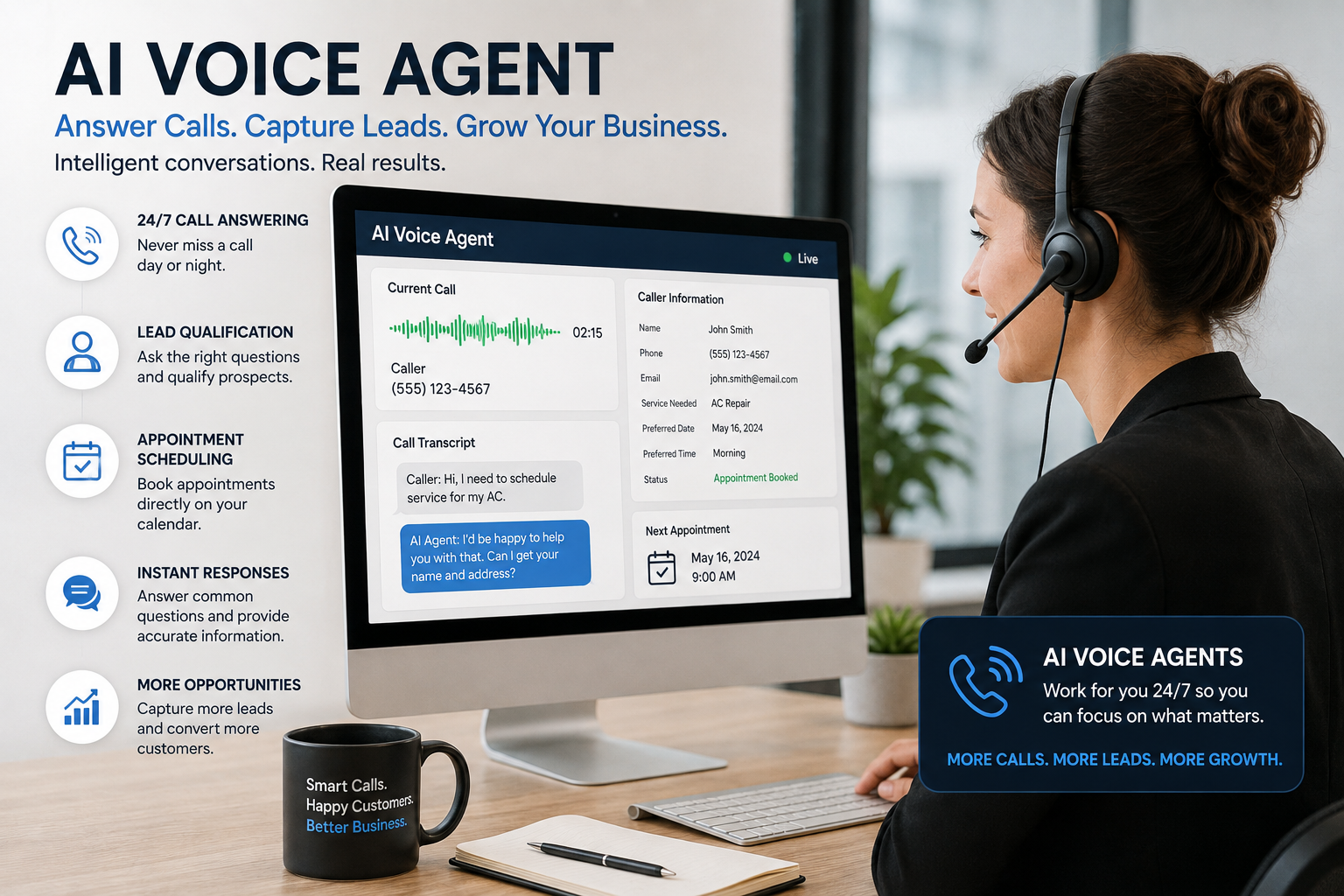
This ability to turn inquiries into appointments is one of the ways AI voice agents can help small businesses capture more leads.
5. CRM Integration
Connecting an AI voice agent to a customer relationship management system can make it much more useful.
Instead of leaving information buried inside a call transcript, the system may be configured to create or update a lead record.
Depending on the integration, the agent could potentially capture:
- Caller name
- Phone number
- Email address
- Service requested
- Lead source
- Qualification information
- Appointment information
- Call outcome
More sophisticated integrations generally require additional setup.
6. SMS Follow-Up
Some businesses want their voice agent to send information after the call.
For example, a caller might receive:
- Appointment confirmation
- Scheduling link
- Business address
- Additional information
- Follow-up instructions
SMS functionality may involve additional telecommunications costs and compliance requirements.
7. Call Transfers
Many businesses want qualified callers transferred directly to an employee.
Transfer rules may be simple or sophisticated.
Example: If the caller wants to schedule a consultation, transfer the call to sales.
Another business may want the system to transfer callers who ask for the owner, president, or sales department during business hours while collecting their information for follow-up after hours.
The more customized the workflow, the more configuration and testing may be necessary.
8. Knowledge Base Complexity
An AI voice agent needs accurate information about your business.
A small company offering three services may require a relatively simple knowledge base.
A company with dozens of services, locations, pricing rules, departments, policies, and frequently asked questions may require considerably more information.
A well-designed knowledge base helps the agent provide accurate and consistent answers.
9. Multiple Agents or Departments
Some businesses may only need one AI receptionist.
Others may need specialized agents for:
- Sales
- Customer service
- Scheduling
- After-hours calls
- Lead qualification
- Different locations
- Different languages
Each additional workflow can increase the complexity of the overall system.
10. Ongoing Optimization
Launching an AI voice agent is not necessarily the end of the process.
Real conversations reveal situations that may not appear during initial testing.
For example, callers may:
- Phrase questions unexpectedly
- Interrupt the agent
- Give very short answers
- Ask multiple questions at once
- Request information not included in the knowledge base
- Ask to speak with a person
- Change their mind during the conversation
Reviewing calls and improving the agent over time can significantly improve performance.
Common AI Voice Agent Pricing Models
Providers may structure pricing in several different ways.
Setup Fee Plus Monthly Service
A business pays an initial setup or development fee followed by an ongoing monthly charge.
This model may include configuration, hosting, management, support, and a certain amount of usage.
Monthly Subscription
Some platforms provide standardized packages with different levels of functionality or usage.
Businesses may pay more as they require additional minutes, agents, integrations, or features.
Usage-Based Pricing
Some services primarily charge according to actual usage.
The business might pay according to call minutes or other consumption metrics.
Custom Pricing
More sophisticated implementations may be priced individually.
This is common when a business needs custom workflows, integrations, multiple agents, multiple locations, or substantial call volume.
Don't Compare AI Voice Agents on Price Alone
Suppose Company A offers an AI answering solution for less money than Company B.
At first glance, Company A appears to be the better deal.
But what if Company A only answers calls and takes messages?
Company B's agent may:
- Answer calls
- Qualify the prospect
- Schedule appointments
- Send follow-up information
- Transfer high-value callers
- Update the CRM
- Provide after-hours coverage
Those are fundamentally different services.
The correct question isn't simply:
Which AI voice agent costs less?
It is:
Which solution produces the greatest value for my business?
How Much Is a Missed Call Worth?
This is where businesses should begin thinking about return on investment.
Imagine a plumbing company where an average completed job produces $500 in revenue.
If the company misses 20 legitimate prospective-customer calls every month, those calls could represent thousands of dollars in potential business.
The company doesn't need to convert every missed call for an AI voice agent to provide value.
Recovering just a few additional customers may offset a substantial portion of the cost.
The same principle applies to other industries.
A missed dental patient may represent years of future appointments. A missed HVAC replacement lead could represent thousands of dollars. A missed property-management inquiry could become a lost tenant or property owner. A missed auto repair customer could become repeat business for another shop.
The value of answering a call depends on what a new customer is worth to the business.
Calculate the Potential ROI
Businesses can perform a simple calculation.
Monthly missed calls × qualified opportunity rate × conversion rate × average customer value
For example, suppose a company misses 50 calls per month.
If 40% are legitimate opportunities, that's 20 potential customers.
If 25% would become customers, that's five additional customers.
If an average new customer is worth $600, those missed opportunities represent approximately $3,000 in potential initial revenue.
This is only an illustration. Actual results will vary by business, industry, lead quality, close rate, and customer value.
But it demonstrates why AI voice agent pricing should be considered in relation to revenue opportunities rather than simply as another monthly expense.
AI Voice Agent vs. Hiring Another Receptionist
Another useful comparison is the cost of additional staffing.
Hiring an employee involves more than hourly wages. Businesses may also have costs associated with:
- Payroll taxes
- Benefits
- Training
- Recruiting
- Equipment
- Workspace
- Management
- Vacation coverage
- Sick leave
An employee can also only handle a limited number of conversations at one time.
An AI voice agent is not a direct replacement for every function performed by a receptionist. Human employees remain extremely valuable for complex conversations, judgment, relationship building, and situations requiring empathy.
However, automating repetitive telephone tasks can reduce the amount of staff time spent on routine interactions.
AI Voice Agent vs. Traditional Answering Service
Traditional answering services can provide valuable human call coverage.
A traditional answering service may primarily:
- Answer calls
- Follow a script
- Take messages
- Forward information
An advanced AI voice agent may be able to:
- Answer the call
- Determine caller intent
- Qualify the lead
- Answer common questions
- Schedule an appointment
- Transfer the caller
- Send follow-up information
- Record the outcome
- Trigger additional automation
For businesses that want more than message-taking, the additional automation can be significant.
What Businesses Get the Most Value From AI Voice Agents?
AI voice agents can be especially valuable for businesses where telephone calls directly generate revenue. You can also explore 25 industries that can benefit from AI voice agents.
HVAC Companies
HVAC companies often receive calls when customers need immediate assistance. Missing the call can mean losing the job to another contractor.
Plumbing Companies
Plumbing inquiries can be urgent. The company that answers first may have an advantage in capturing the customer.
Dental Offices
AI voice agents for dental offices can help handle appointment inquiries, common questions, and prospective-patient calls.
Auto Repair Shops
An AI voice agent for an auto repair shop can collect vehicle and service information and help customers take the next step without interrupting technicians.
Property Management Companies
Property management companies may receive calls from prospective tenants, residents, vendors, and property owners. AI can help identify the caller's needs and route the conversation appropriately.
When Is an AI Voice Agent Worth the Investment?
An AI voice agent may be worth considering if your business:
- Regularly misses calls
- Receives calls after hours
- Depends heavily on telephone leads
- Has employees repeatedly answering the same questions
- Needs faster lead response
- Schedules appointments by phone
- Wants to qualify prospects before transferring them
- Experiences periods of high call volume
- Wants to automate telephone follow-up
- Wants more consistent call handling
The more valuable each incoming call is, the easier it may be to justify the investment.
Questions to Ask Before Buying an AI Voice Agent
Before choosing a provider, ask exactly what is included.
- Is there a setup fee?
- What is the monthly charge?
- How much usage is included?
- What are the overage charges?
- Can the agent answer calls 24/7?
- Can it schedule appointments?
- Can it transfer calls?
- Can it send SMS messages?
- Can it integrate with our CRM?
- Can the knowledge base be updated?
- Who optimizes the agent after launch?
- Are call recordings or transcripts available?
- Can we review call outcomes?
- What support is included?
The Cheapest AI Voice Agent May Not Be the Best Value
AI voice technology is becoming increasingly accessible, but businesses should avoid choosing a solution solely because it has the lowest advertised price.
The quality of the conversation matters.
The setup matters.
The knowledge base matters.
The integrations matter.
The transfer rules matter.
The follow-up process matters.
Most importantly, the results matter.
A voice agent that costs slightly more but captures several additional customers every month may be far more valuable than a cheaper system that simply answers the telephone.
Think About Revenue, Not Just Cost
The purpose of an AI voice agent should not be to add another technology bill.
It should solve a business problem.
That problem might be missed calls, slow lead response, after-hours coverage, employees spending too much time answering routine questions, or prospects failing to schedule appointments because nobody was available when they called.
These capabilities are part of the broader shift toward AI automation for small businesses.
The real financial question is therefore:
What is the cost of continuing to handle calls the way you do today?
Once you know that number, evaluating the potential value of an AI voice agent becomes much easier.
Find Out What an AI Voice Agent Would Cost for Your Business
Every business has different call volumes, workflows, scheduling requirements, and customer-service needs.
Stevendev Marketing builds customized AI voice agents that can answer calls, capture leads, qualify prospects, schedule appointments, route callers, transfer qualified opportunities, and provide after-hours coverage.
Schedule a consultation with Stevendev Marketing to discuss your business, your call-handling needs, and the AI voice agent solution that's right for you.
Frequently Asked Questions
How much does an AI voice agent cost?
Pricing varies according to the provider, call volume, features, integrations, customization, and ongoing support. Businesses should request pricing based on their specific requirements rather than relying solely on advertised starting prices.
Do AI voice agents have monthly fees?
Many AI voice agent services use monthly subscriptions, usage charges, or a combination of setup fees and ongoing service fees.
Are there additional charges for call minutes?
There can be. Some providers include a certain amount of usage while others charge based on call minutes or consumption. Businesses should ask exactly what is included.
Is an AI voice agent cheaper than hiring a receptionist?
It can be less expensive for certain repetitive call-handling functions, but the two are not identical. Human employees provide capabilities such as judgment, empathy, relationship building, and complex problem-solving that AI should not be expected to replace in every situation.
Can an AI voice agent schedule appointments?
Yes. When connected to a compatible scheduling platform, an AI voice agent can potentially check availability and help callers schedule appointments during the conversation.
Can an AI voice agent pay for itself?
Potentially. The return depends on factors such as the number of calls currently missed, lead quality, conversion rates, customer value, operating costs, and how effectively the agent is implemented.