What Is an AI Voice Agent and How Does It Work?
Discover how AI voice agents answer calls, capture leads, book appointments, and help businesses provide 24/7 customer service.

What Is an AI Voice Agent and How Does It Work?
What Is an AI Voice Agent and How Does It Work?
For many businesses, the telephone is still one of the most valuable ways a new customer makes contact. A potential customer may call because they need an appointment, have a question, want a price estimate, or need immediate service.
The problem is simple: someone has to answer.
Employees may already be helping customers. Calls may arrive after business hours. A receptionist may be away from the desk. During busy periods, several people may call simultaneously.
Every unanswered call can potentially become a lost customer.
AI voice agents offer businesses another way to manage these conversations.
An AI voice agent can answer telephone calls, speak naturally with callers, respond to common questions, collect information, qualify prospects, schedule appointments, route calls, and perform other predefined tasks.
Instead of simply asking callers to "press 1 for sales," today's AI voice technology can have an actual conversation with them.
Here's how it works and why businesses are increasingly interested in the technology.
What Is an AI Voice Agent?
An AI voice agent is artificial intelligence software designed to communicate with people through spoken conversation.
Think of it as a digital employee specifically trained to handle telephone conversations.
Depending on how it is configured, an AI voice agent can:
- Answer incoming calls
- Make outbound calls
- Respond to frequently asked questions
- Collect caller information
- Qualify prospective customers
- Schedule appointments
- Send follow-up information
- Route calls to the appropriate person
- Transfer qualified prospects to sales
- Handle routine customer-service requests
- Provide information about products and services
- Take messages
- Follow up with leads
The business determines what the agent should say, what information it should collect, and what actions it should take.
This makes an AI voice agent very different from a traditional recorded telephone menu.
AI Voice Agents vs. Traditional Phone Menus
Most people have experienced an Interactive Voice Response, or IVR, system.
You call a company and hear:
"Press 1 for sales. Press 2 for customer service. Press 3 for billing."
Although IVR systems can route calls efficiently, they generally require callers to navigate predefined menus.
An AI voice agent works differently.
A caller might simply say:
"I need someone to look at my air conditioner tomorrow."
The AI agent can determine what the caller wants, ask follow-up questions, collect the necessary information, and potentially schedule an appointment.
The interaction becomes a conversation instead of a menu.
That distinction is one of the biggest reasons conversational AI is changing business phone systems.
How Does an AI Voice Agent Work?
Several technologies work together to create an AI voice conversation.
1. The Customer Speaks
The process begins when someone calls the business and starts talking.
Instead of requiring specific commands, modern voice systems can recognize ordinary spoken language.
A caller might say:
"My kitchen sink is leaking and I need someone to come out."
2. Speech Is Converted Into Text
Speech-recognition technology converts the caller's spoken words into information the AI system can process.
This technology is commonly known as speech-to-text or automatic speech recognition.
Modern systems can process conversational speech rather than requiring callers to speak like they are giving commands to a machine.
3. Artificial Intelligence Determines What the Caller Wants
The AI then analyzes the conversation to determine the caller's intent.
For example, the caller may want to:
- Schedule service
- Ask about pricing
- Change an appointment
- Request emergency assistance
- Speak with a salesperson
- Ask a common question
The agent can use the conversation, its instructions, and the business's knowledge base to determine how it should respond.
4. The Agent Generates a Response
Once the system understands the request, it determines an appropriate response.
For example:
"Absolutely. I can help you with that. Can I get your name and the address where you need service?"
The conversation can continue naturally while the agent gathers the information required by the business.
5. The Response Is Spoken to the Caller
Text-to-speech technology converts the AI-generated response into spoken audio.
Modern AI voices can include natural pacing, pauses, and conversational intonation.
The objective is to make the interaction comfortable and easy for the caller while efficiently completing the requested task.
6. The Agent Takes Action
This is where AI voice agents become particularly useful.
The conversation does not necessarily end with answering a question.
Depending on the integrations and configuration, an agent may be able to:
- Add information to a CRM
- Schedule an appointment
- Check calendar availability
- Transfer a call
- Send an SMS message
- Send appointment information
- Create a lead
- Trigger a follow-up workflow
- Record the outcome of the conversation
The voice conversation becomes part of a larger business automation system.
What Can Businesses Use AI Voice Agents For?
AI voice agents can perform different jobs depending on the needs of the organization.
24/7 Call Answering
Customers do not always call during normal business hours.
Someone may discover a plumbing leak at 11:00 p.m., remember to schedule a dental appointment on Sunday afternoon, or search for an HVAC company early in the morning.
An AI voice agent can provide coverage when employees are unavailable.
That allows a business to capture opportunities that might otherwise become voicemail messages—or calls to competitors.
Lead Qualification
Not every inquiry is equally valuable.
An AI voice agent can ask predetermined questions to determine whether a caller meets the company's qualification criteria.
The agent might ask about:
- Type of service needed
- Location
- Timeframe
- Budget
- Property type
- Current problem
- Preferred appointment date
Qualified prospects can then be routed appropriately.
Appointment Scheduling
Scheduling is one of the most valuable applications of voice AI.
Instead of having employees repeatedly check calendars and coordinate appointment times, an AI agent can potentially connect with the company's scheduling system.
The customer can discuss available times during the call and book an appointment without waiting for an employee.
Frequently Asked Questions
Employees often answer the same questions repeatedly.
"What time do you close?"
"Do you service my area?"
"Do you offer emergency service?"
"Do you accept new patients?"
"How do I schedule an appointment?"
An AI voice agent can answer approved questions using information provided by the business.
This allows employees to spend more time handling situations that actually require human attention.
Call Routing and Transfers
AI does not mean humans disappear from the process.
In many cases, the best system combines automation with human assistance.
For example, an AI voice agent might handle the beginning of the conversation, determine what the caller needs, and then transfer the call to the correct person.
High-value prospects can be transferred directly to sales while routine questions remain automated.
Outbound Lead Follow-Up
Voice agents can also be used for appropriate outbound calling.
A business may use an outbound AI agent to follow up with people who have requested information, confirm appointments, reconnect with leads, or determine whether a prospect wants to speak with someone.
Businesses using automated outbound communications should make sure their calling and messaging practices comply with applicable consent, telemarketing, privacy, and communications laws.
AI Voice Agents vs. Human Receptionists
AI voice agents do not necessarily need to replace human receptionists.
They can complement them.
Human employees are valuable when conversations require judgment, empathy, negotiation, unusual problem-solving, or detailed knowledge.
AI can handle many repetitive interactions.
A business could therefore use AI to answer routine calls and allow employees to concentrate on higher-value work.
For example, the AI agent could collect basic information before transferring the caller.
Instead of an employee spending several minutes determining why someone is calling, the employee receives a caller whose needs have already been identified.
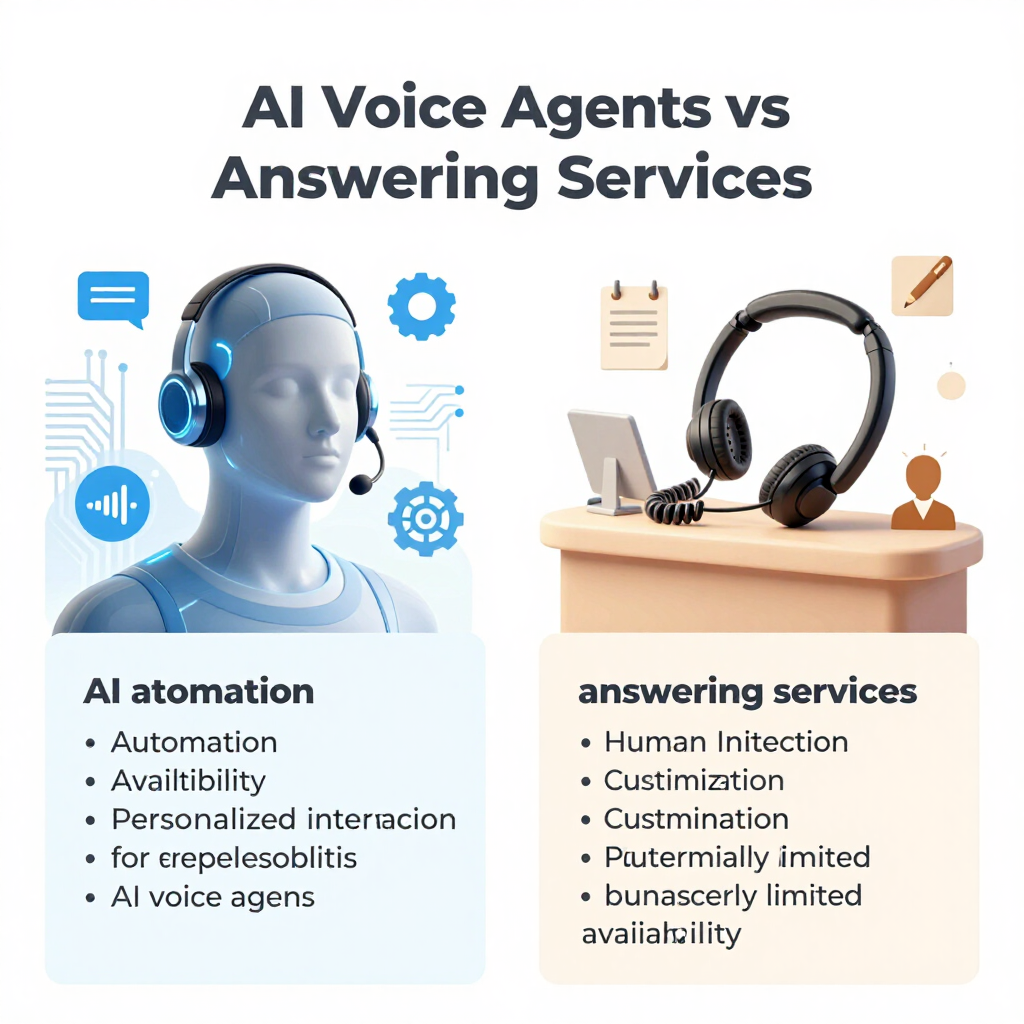
AI Voice Agents vs. Answering Services
Traditional answering services generally rely on human operators who answer calls for multiple businesses.
They can be useful, but AI voice agents provide another option.
An AI agent can be customized around a company's specific services, policies, qualification questions, scheduling rules, and call-transfer procedures.
It can also handle multiple conversations without requiring a business to maintain a large receptionist team.
The right solution depends on the company's needs, call complexity, customer expectations, and budget.
What Types of Businesses Can Use AI Voice Agents?
Voice agents can be useful anywhere telephone calls play an important role in generating or serving customers.
Examples include:
HVAC Companies
An AI voice agent can answer calls about heating and cooling problems, collect information, identify urgent service requests, and help schedule appointments.
Plumbing Companies
Plumbing leads can be extremely time-sensitive. An AI agent can answer when employees are busy or after hours and collect the information necessary to begin the service process.
Dental Offices
Voice agents can help answer routine questions, collect prospective patient information, and assist with appointment scheduling.
Auto Repair Shops
An AI agent can collect vehicle information, determine the requested service, and help customers schedule appointments.
Property Management Companies
Property managers receive calls from prospective tenants, current residents, vendors, and property owners.
AI can help identify why someone is calling and direct the conversation appropriately.
Other potential applications include legal offices, medical practices, home-service companies, real estate businesses, insurance agencies, restaurants, salons, contractors, and many other service businesses.
What Are the Benefits of AI Voice Agents?
The specific benefits depend on how the system is implemented, but several advantages are particularly important.
Fewer Missed Opportunities
When a potential customer calls a business and nobody answers, that person may simply call the next company.
Answering more calls gives the business more opportunities to convert inquiries into appointments and customers.
Availability Outside Normal Business Hours
An AI agent can continue answering calls when the office is closed.
That can be particularly valuable for businesses where customers frequently search for services at night or on weekends.
Consistent Customer Experience
Businesses can establish specific instructions for how their agents should greet callers, collect information, answer questions, and route calls.
This creates greater consistency across conversations.
Reduced Repetitive Work
AI can handle many routine conversations, allowing employees to concentrate on work that requires human expertise.
Scalability
A sudden increase in calls can overwhelm a small office.
AI systems can help businesses manage higher call volumes without requiring a receptionist to handle every conversation personally.
Faster Lead Response
Speed matters.
When someone requests information, waiting hours—or even days—for a response can reduce the likelihood of converting that prospect.
AI voice agents can help businesses respond immediately.
Can AI Voice Agents Sound Natural?
Voice technology has improved significantly.
Modern AI systems can use realistic voices, conversational pacing, interruptions, and context from earlier parts of a conversation.
However, the technology alone does not determine whether an agent provides a good experience.
The design of the conversation matters just as much.
A poorly configured agent can sound repetitive, ask unnecessary questions, or provide awkward responses.
A properly designed agent should know:
- How to greet callers
- Which questions to ask
- When to stop asking questions
- How to interpret short answers
- What information it is allowed to provide
- What it should never say
- When to transfer the call
- How to handle an interruption
- How to close the conversation
Testing and optimization are therefore important parts of deploying an AI voice agent.
Will AI Voice Agents Replace Employees?
For many businesses, the more useful question is not whether AI will replace employees.
It is:
Which telephone tasks actually require an employee?
Answering the same five questions hundreds of times may not be the best use of an employee's time.
AI can handle repetitive tasks while people focus on conversations that require expertise, decision-making, relationship building, or complex problem-solving.
The result can be a hybrid model in which AI handles routine interactions and humans handle the conversations where they provide the greatest value.
What Should You Look for in an AI Voice Agent?
Businesses considering voice AI should evaluate more than the sound of the voice.
Important considerations include:
Conversation design: Can the agent handle natural conversations instead of simply reading a script?
Knowledge: Can it accurately answer questions about the business?
Call transfers: Can callers easily reach a human when necessary?
Scheduling: Can the system connect with the company's calendar or appointment platform?
Lead capture: Can caller information be stored or sent to the appropriate system?
SMS capabilities: Can the system send approved follow-up information when appropriate?
Customization: Can the agent be configured around the company's actual processes?
Reporting: Can the business review call outcomes and identify opportunities for improvement?
Compliance: Can the implementation support the business's legal, privacy, disclosure, consent, and industry-specific requirements?
An AI voice agent should fit the business rather than forcing the business to redesign everything around the technology.
The Future of Business Phone Calls
Customers increasingly expect businesses to respond quickly.
At the same time, businesses face pressure to control labor costs, improve customer service, and generate more revenue from existing marketing.
AI voice agents address all three challenges.
They allow businesses to automate routine conversations while still giving callers the ability to speak naturally.
As conversational AI improves, the distinction between websites, phone systems, CRMs, scheduling software, and automated follow-up will continue to shrink.
A phone call will no longer simply be a conversation.
It can become the beginning of an automated workflow that captures the lead, qualifies the prospect, schedules the appointment, sends confirmation information, and alerts the appropriate employee.
Is an AI Voice Agent Right for Your Business?
If telephone calls are important to your business, it is worth considering what happens when nobody answers.
How many calls go to voicemail?
How many arrive after hours?
How much employee time is spent answering repetitive questions?
How quickly are new leads contacted?
How many potential customers call a competitor because they could not immediately reach someone?
An AI voice agent can help address these problems by giving businesses an intelligent, automated way to handle telephone conversations.
The objective is not simply to answer more calls.
It is to turn more conversations into appointments, qualified leads, satisfied customers, and revenue.
See What an AI Voice Agent Can Do for Your Business
Stevendev Marketing builds customized AI voice agents designed around the way your business actually operates.
Your agent can be configured to answer calls, respond to common questions, qualify prospects, capture lead information, schedule appointments, route callers, transfer qualified opportunities, and provide after-hours coverage.
Instead of wondering whether AI voice technology could work for your company, experience it yourself.
Schedule a consultation with Stevendev Marketing and discover how an AI voice agent can help your business answer more calls, capture more opportunities, and provide better service.
Frequently Asked Questions
What is an AI voice agent?
An AI voice agent is software that uses artificial intelligence, speech recognition, and voice technology to communicate with people over the telephone. It can answer questions, collect information, schedule appointments, qualify leads, and perform other automated tasks.
Can an AI voice agent answer calls 24/7?
Yes. AI voice agents can be configured to answer calls outside normal business hours, including nights and weekends.
Can an AI voice agent transfer calls to a real person?
Yes. Depending on the phone system and configuration, an AI agent can transfer callers to employees or departments when predetermined conditions are met.
Can AI voice agents schedule appointments?
Yes. When integrated with a compatible scheduling system, an AI voice agent can help callers select available appointment times and schedule appointments.
Can AI voice agents make outbound calls?
Yes. AI voice agents can support outbound use cases such as following up with people who requested information, appointment reminders, and lead follow-up. Businesses should ensure their use complies with applicable calling, consent, and telemarketing requirements.
Are AI voice agents only for large companies?
No. Small and midsize businesses can benefit significantly because they often have limited staff available to answer calls throughout the day.
What businesses benefit most from AI voice agents?
Businesses that depend heavily on telephone leads and appointments can be strong candidates, including HVAC companies, plumbers, dental offices, auto repair shops, property management companies, contractors, and other service businesses.
Recent Posts